
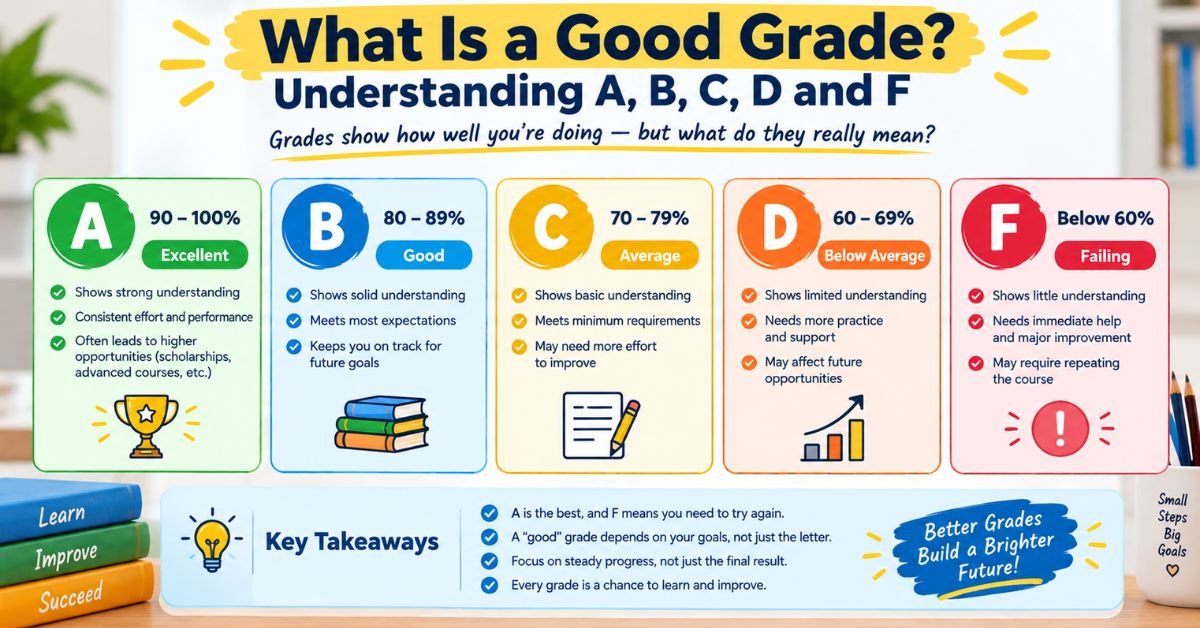
Wondering whether your grade is good? The answer depends on your goals, your school’s grading scale, and the subject you are studying. A percentage that earns an A in one class may fall into a different letter grade in another, so it helps to understand how the system works before judging your results.
In this guide, we’ll explain the common A–F grading system, show how percentages are often converted into letter grades, and share practical ways to understand your progress. If you already have your scores, the Grade Calculator can help you check your overall grade.
What do A, B, C, D, and F grades mean?
Many schools use letter grades to summarize a student’s performance. Although exact definitions vary, the letters generally communicate how well a student has met the course requirements.
- A: Excellent or outstanding performance.
- B: Good performance and a strong understanding of most course material.
- C: Satisfactory performance that meets the basic course expectations.
- D: Below-average performance; it may count as passing in some courses, but not all.
- F: Failing performance, usually meaning the minimum course requirements were not met.
These are general descriptions, not universal rules. Some programs require a C or higher for a course to count toward a major, while other classes may have different pass requirements. Always check your course syllabus or school handbook.
Common percentage-to-letter-grade scale
The table below shows one commonly used grading scale. Treat it as an example, not a guarantee of how your school assigns grades.
| Letter grade | Example percentage range | General meaning |
|---|---|---|
| A | 90–100% | Excellent |
| B | 80–89% | Good |
| C | 70–79% | Satisfactory |
| D | 60–69% | Below average |
| F | Below 60% | Failing |
Some schools use plus and minus grades, such as A− or B+. Others use a 7-point scale, a 10-point scale, standards-based grading, or a curve. A 90% might be an A at one school and an A− at another. The official scale for your class is the one that matters.
Is a B or C a good grade?
A B is often considered a good result because it usually reflects solid understanding of the material. A C can also be a reasonable result, especially in a challenging course, but whether it meets your needs depends on course requirements and personal goals.
Instead of looking only at the letter, consider your progress. Did your score improve after you changed how you studied? Are you meeting the requirements for your next course? Do you understand the topics you will need later? Those answers give a fuller picture than a single letter.
How to understand your overall grade
Your final grade may be based on homework, quizzes, projects, tests, participation, and a final exam. In a points-based class, your percentage is generally the points earned divided by the points possible, multiplied by 100. In a weighted class, each category contributes a specified share of the final grade.
For example, if homework counts for 20%, tests for 50%, and a final project for 30%, you need to account for each category’s weight. Simply averaging the three category percentages would be inaccurate unless they were equally weighted. Use your syllabus to confirm the weights, then check your calculation with the Grade Calculator.
How can you improve your grade?
- Find the biggest opportunity. Check upcoming assignments and how much each one counts.
- Review feedback. Look for repeated mistakes instead of only checking the final score.
- Ask specific questions. Bring a problem or concept you do not understand to your teacher or tutor.
- Practice actively. Solve sample questions from memory instead of only rereading notes.
- Plan ahead. Break revision into short sessions and leave time to revisit difficult topics.
There is no single study method that works for everyone. Try a practical change, track whether it helps, and adjust as needed. If a grade is lower than expected, ask what you can improve before the next assessment.
Frequently asked questions
Is 80% a good grade?
On many grading scales, 80% is a B and is generally considered a good result. Check your school’s grading policy because cutoffs can differ.
Is 70% passing?
In many schools, 70% is passing, but the minimum may be higher for particular programs or courses. Confirm the requirement with your instructor or handbook.
Does every school use the same grading scale?
No. Percentage ranges, plus/minus grades, and passing requirements can vary by school, teacher, course, and country.
Use your grade as useful feedback
A letter grade is a quick summary, but it does not tell the whole story. Learn the grading rules for your class, look at your progress over time, and focus on the skills you can improve. For more help checking your scores, visit the NumNest and explore the available calculators.